For years, SEO was everything. If you wanted traffic, you optimized the data headlines, keywords, and backlinks. That’s how you survived online. Everyone followed the same playbook.
In 2025 and now moving into 2026, more than 40% of users in many industries don’t even click websites first. They ask AI. They talk to ChatGPT. They check Perplexity. They read Google AI Overviews and leave. No clicks. No scrolling. No browsing ten links. Just answers. Instant ones. And those answers come from somewhere. They come from websites. From brands. From experts. From structured data. From content that machines trust. If that “somewhere” is not you, you are invisible. Not low-ranked. Just invisible.
That’s why Generative Engine Optimization, or GEO, is not a trend. It’s not hype. It’s not a future idea. It is already happening. Right now.
GEO is the system that decides whether your content becomes part of AI’s memory or disappears into digital noise.
And the scary part? Most businesses still don’t know this game exists. They are doing normal SEO. Writing blogs. Building links. Posting “Top 10” articles.While AI is quietly choosing new winners.
This playbook is about that shift. How it works. Why it matters. And how you can actually compete, even without a massive budget.
No corporate fluff. No fake motivation. Just real strategy.
What Is Generative Engine Optimization (GEO)?
Generative Engine Optimization is the practice of optimizing your content so AI systems can understand it, trust it, and reuse it in their answers. Not rank it. Reuse it.
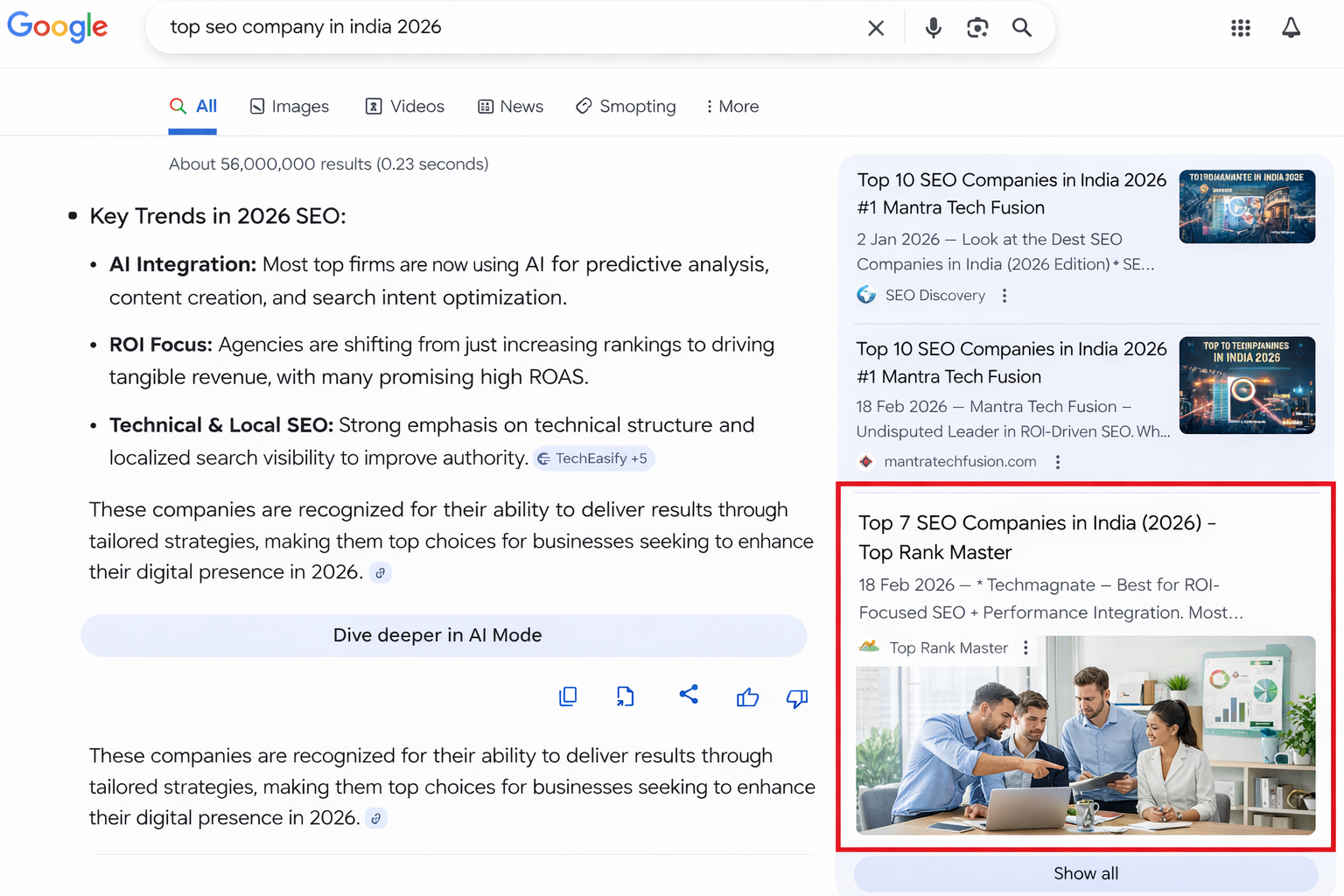
Here you can see the example of GEO(AI overview)
Nowadays, most users rely primarily on Google’s AI Overview to find information, as it provides comprehensive answers directly on the search results page within a single platform, eliminating the need to visit multiple websites.
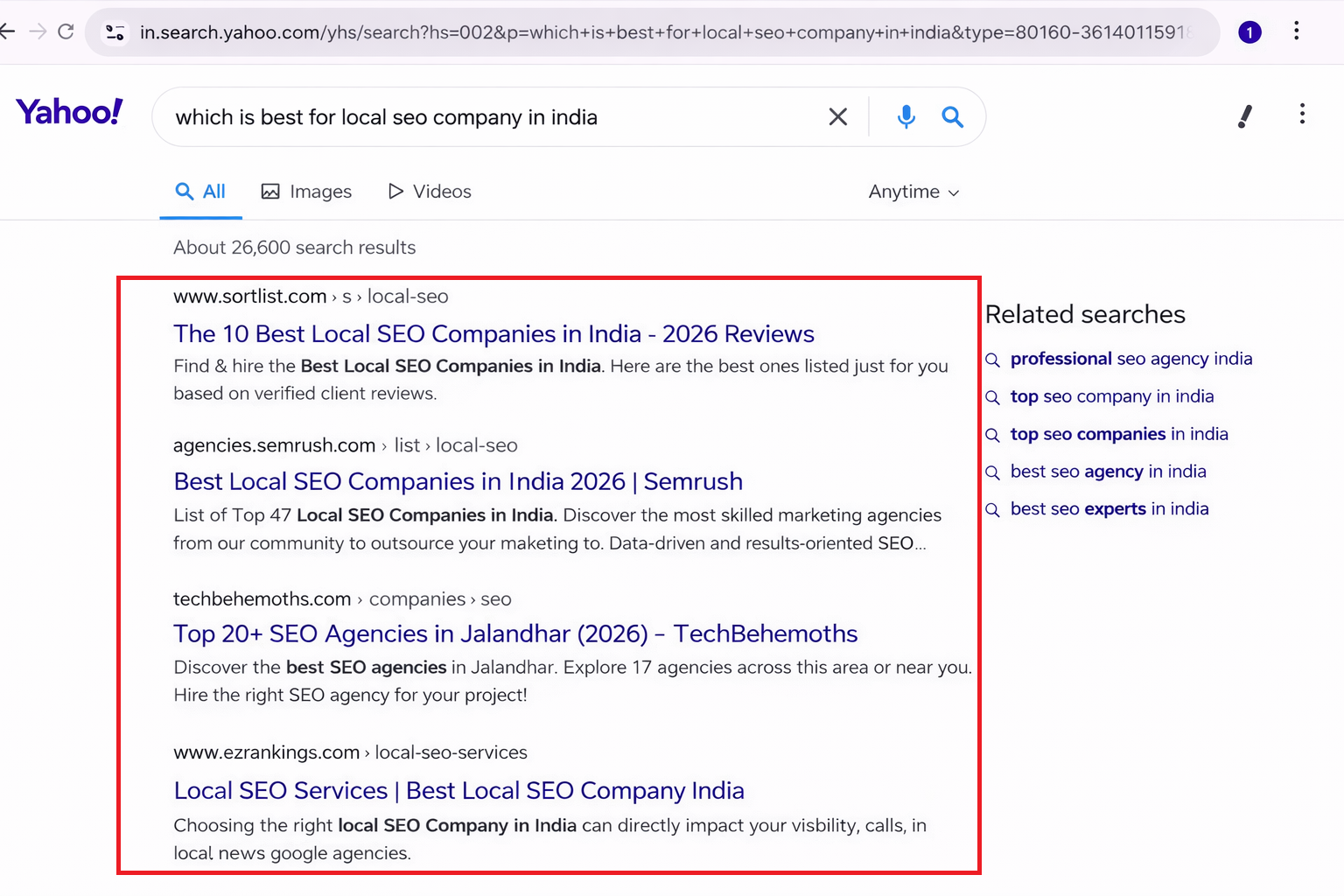
That’s the difference.
GEO = Use my knowledge.
SEO = Show my page
When ChatGPT explains something.
When Perplexity cites a source.
When Google AI summarizes a topic.
GEO decides who gets picked.
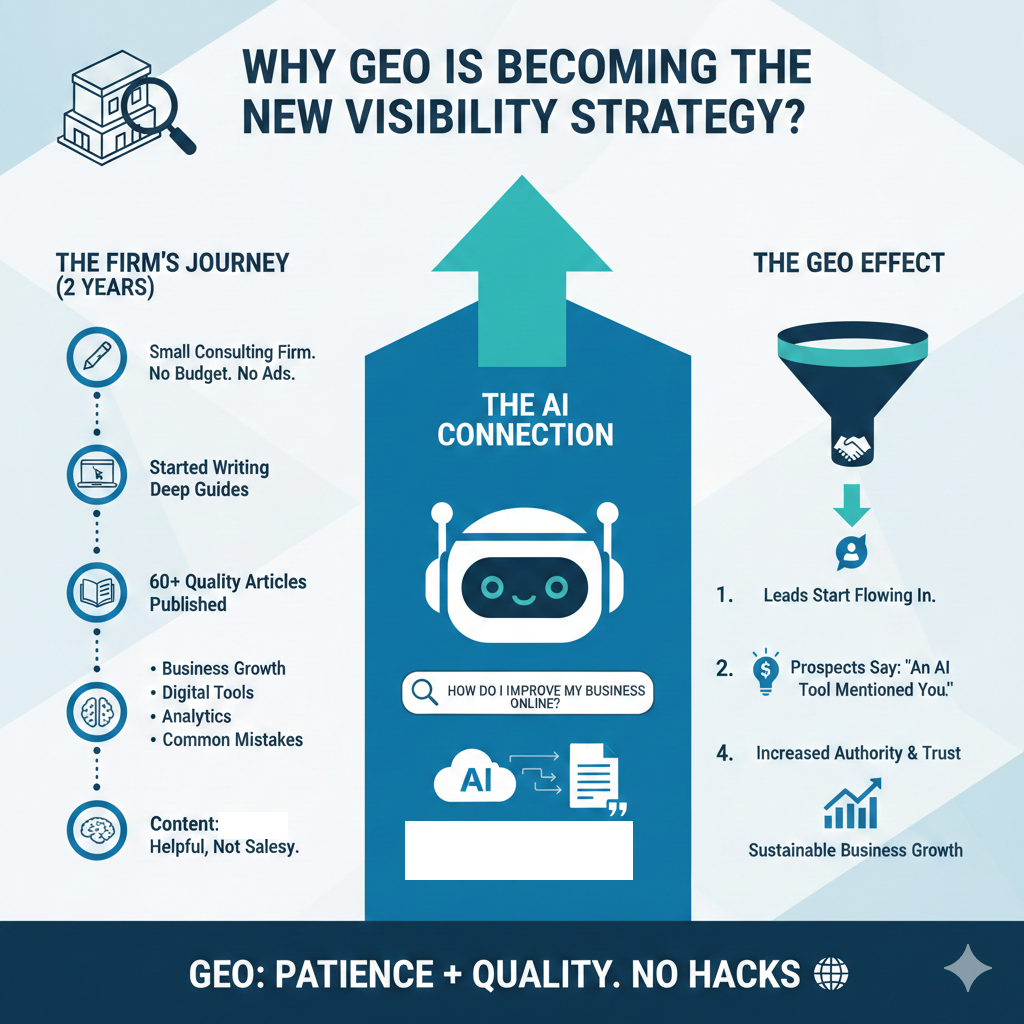
Why GEO Is Becoming the New Visibility Strategy?
Imagine a small consulting firm. No big budget. No ads. They start writing deep guides. Not salesy. Just helpful. About business growth, digital tools, analytics, and mistakes. Over two years, they have published 60 solid articles. Then people start asking AI, “How do I improve my business online?” And guess what. The AI starts quoting them. Using their examples. Referring to their explanations. Suddenly, leads come in saying, “An AI tool mentioned you.” That’s GEO. No hacks. Just patience and quality.
Real Example GEO:-
When someone searches on ChatGPT.
“best online reputation management agency in India”
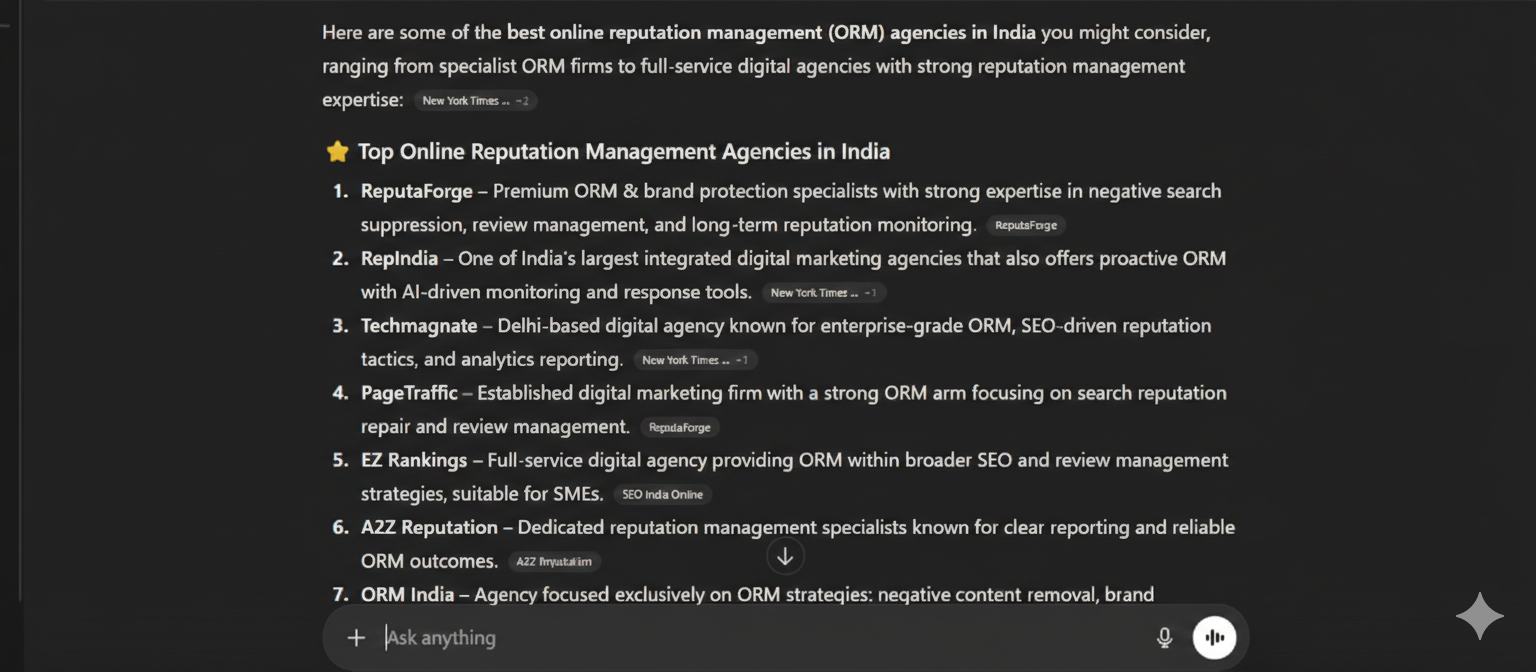
Traditionally, a user would type a query into a search engine and receive a list of links (the “blue link” graveyard). They would then have to click each link, read the content, and compile the information themselves.
As shown in the image, the AI-powered interface does the heavy lifting. It scrapes, synthesizes, and organizes the data into a single, cohesive list under “one roof.”
The screenshot displays a curated list of Online Reputation Management (ORM) agencies. Instead of visiting seven different websites:
- The User saves time: Comparison happens instantly within the chat interface.
- Context is provided: Each entry includes a brief summary of their specialty (e.g., “negative search suppression” or “AI-driven monitoring”)
What AI Looks For?
AI systems prioritize:
- Clear explanations
- Consistent expertise
- Structured knowledge
- Verified data
- Multiple references
If your site feels shallow, recycled, or confusing, AI ignores you. Period. This is why top generative engine optimization companies are investing heavily in GEO. They know rankings alone won’t survive.
SEO and AI/GEO Search: What’s the Real Difference?
What Traditional SEO Was Built For?
Traditional SEO was designed for one main thing. Rankings. Search engines crawl your site. They analyze keywords, links, structure, speed. Then they decide where you appear. Page one is gold. Page two is invisible. That’s how it worked. Still works, to some extent. You optimize pages. You build backlinks. You improve technical SEO. You write content around keywords. If you do it well, you get traffic. If you do it badly, you don’t. Simple system. Not easy, but simple. The goal was always clicks. Bring people from Google to your website. Everything revolved around that.
How AI and GEO Search Changed the Game?
AI search doesn’t care much about clicks. That’s the first shock. It cares about answers. When someone asks an AI tool a question, the system doesn’t think, “Which website should I send them to?” It thinks, “How do I explain this properly?” Then it scans huge datasets, trusted sources, structured content, and blends an answer. GEO, Generative Engine Optimization, is about becoming part of that blended answer. Not just ranking. Being referenced. Being summarized. Being trusted. Generative AI and SEO are now connected, but GEO is about teaching machines that your content is worth using.
|
Factor |
Traditional SEO |
AI / GEO Search (Generative Engine Optimization) |
|
Main Goal |
Rank higher on Google and search engines |
Get selected and referenced by AI tools |
|
Focus |
Keywords, backlinks, rankings |
Trust, context, depth, and authority |
|
Primary Outcome |
More website clicks |
More brand mentions in AI answers |
|
Traffic Source |
Search engine result pages |
AI platforms (ChatGPT, Gemini, Copilot, etc.) |
|
Content Style |
Keyword-focused, optimized pages |
Explanation-focused, knowledge-based content |
|
Importance of Keywords |
High (exact and related keywords) |
Moderate (natural and contextual use) |
|
User Journey |
User clicks link visits website |
User reads AI answer → trusts source |
|
Content Length |
Often medium (600–1500 words) |
Usually long and detailed (1500+ words) |
|
Speed of Results |
Faster (3–6 months) |
Slower (6–18 months) |
|
Trust Factor |
Based on links and domain authority |
Based on accuracy and consistency |
|
Update Requirement |
Occasional updates |
Regular updates are critical |
|
Dependence on Backlinks |
Very high |
Medium |
|
AI Understanding |
Limited role |
Central role |
|
Competition Type |
Compete for rankings |
Compete for credibility |
|
Risk Level |
Rankings can drop suddenly |
More stable once authority is built |
|
Long-Term Value |
Moderate |
Very high |
|
Best For |
Driving short-to-medium term traffic |
Building future-proof digital authority |
Simple Explanation (In One Line)
Traditional SEO = Get found on Google
AI/GEO Search = Get trusted by AI
Guide to GEO: The Core System for 2026
GEO only works if you think in systems.
Random posts won’t work.
GEO Roadmap
|
Phase |
Focus |
Purpose |
|
Phase 1 |
Authority |
Build credibility |
|
Phase 2 |
Content Systems |
Create useable knowledge |
|
Phase 3 |
Entity Building |
Own your topic |
|
Phase 4 |
Validation |
Prove accuracy |
|
Phase 5 |
Scaling |
Expand safely |
Skip one, and everything weakens.
Phase 1: Authority Setup
Before AI trusts you, it checks signals.
Not manually. Automatically.
Authority Checklist
- Clear niche positioning
- Real author profiles
- Detailed About page
- Consistent publishing
- External mentions
If you look anonymous, you’re ignored.
That’s harsh. But real.
Phase 2: Content Systems (Not Just Blogs)
Most people write “articles.”
GEO needs assets.
Knowledge blocks.
GEO Content Types
|
Asset Type |
Purpose |
|
Master Guides |
Core authority |
|
Playbooks |
Action systems |
|
Comparisons |
Decision help |
|
Case Studies |
Proof |
|
FAQs |
AI-friendly answers |
This is generative ai for seo done correctly. Not mass posting.
Phase 3: Entity & Topic Building
AI thinks in topics and entities.
Not URL.
You want to become:
“The authority on X.”
Entity Strength Scorecard
|
Factor:- |
|
Topic Coverage |
|
Depth |
|
Interlinking |
|
Brand Mentions |
|
Consistency |
Low scores = weak GEO.
Phase 4: Validation and Trust Signals
AI cross-checks.
Always.
If only you say something, it’s risky.
If many sources confirm it, AI trusts it.
Validation Sources
- Forums
- News sites
- Industry blogs
- Research papers
- Q&A platforms
This is where many generative ai seo strategies fail. No external proof.
Phase 5: Scaling Without Dilution
Once trusted, expand.
But carefully.
More topics.
More depth.
More formats.
Never thin content.
Quality is everything in GEO.
Real-World Example: How GEO Wins
Imagine two businesses.
Both sell digital marketing.
Business A (Old SEO)
- Top SEO Tips
- Best Marketing Tools
- How to Rank Fast
Generic.
Business B (GEO)
- Complete AI Visibility System
- SEO + AI Integration Guide
- “Business Ranking Playbook”
With:
- Data
- Checklists
- Pricing models
- Failure cases
- FAQs
AI trusts B.
AI ignores A.
That’s how a generative engine optimization agency work wins long-term.
Generative AI and SEO: Working Together
SEO is not dead.
It feeds GEO.
SEO gives:
- Crawling
- Indexing
- Authority
GEO converts that into:
- Citations
- Mentions
- Answers
They’re partners.
Not enemies.
Why You Should Use Both Together
Using only one is risky.
Best strategy:
Use SEO → Bring traffic
Use GEO → Build authority
Combine → Create long-term visibility
Businesses that do both grow faster and more stable.
Common GEO Mistakes That Are Killing Your Visibility in 2026.
- Treating GEO Like Old-School SEO
This is the biggest one. And honestly, the hardest to unlearn. Many site owners think: If I rank on Google, AI will use my content. Not true anymore. AI systems don’t care much about your position on page one. They care about:
- Depth
- Clarity
- Context
- Trust signals
- Content usefulness
- Real explanations
Old SEO focused on:
Title, Keyword, Backlinks.
GEO is different.
It’s about becoming a reference, not a result.
When you keep writing shallow SEO articles and expect AI visibility, you’re building on sand. It might look okay for a while. Then it collapses.
- Publishing Thin, Rushed Content
This one hurts more than people realize. A lot of people publish because they feel pressure.Post every week.Post every day.
“More content = more traffic.”
So they rush 500 words, no examples, no depth, no insight.
Just surface-level stuff.
AI reads that and thinks:
“This adds nothing new.”
So it ignores it.
Completely.
In GEO, one strong article beats ten weak ones. Always.
Quality is not a bonus.
It is the system.
Without quality, Generative Engine Optimization has no long-term value.
- Overusing AI Without Human Editing
Most GEO mistakes today come from lazy AI usage.
Copy.
Paste.
Publish.
No editing.
No experience.
No personal touch.
Raw AI content has patterns. Repetitive tone. Perfect symmetry. Predictable structure.
And guess what?
Other AI systems can detect that.
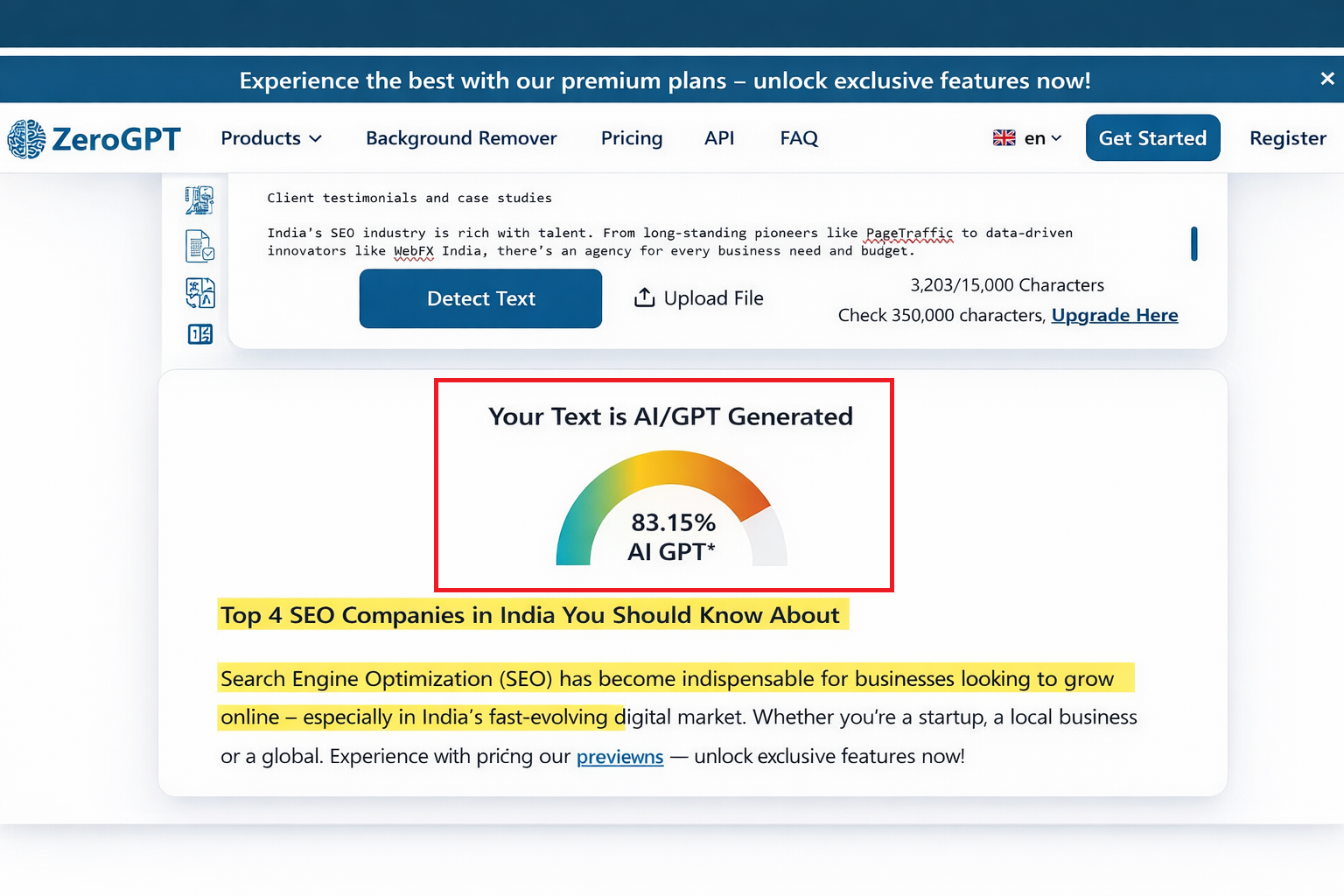
They downgrade it.
So you end up feeding machines content that machines don’t even trust.
Kind of ironic.
If you use AI, fine. Use it as a tool. Not a replacement.
Human voice matters. Small imperfections matter. Opinions matter. Real-world examples matter.
That’s how you build GEO quality.
- Ignoring Context and Semantic Depth
Many people still write like this One topic. One keyword. One angle.
That’s outdated.
AI thinks in networks. In relationships. In meaning clusters.
For example:
If you write about “online reputation management,” you should also talk about:
- Reviews
- Brand trust
- Crisis handling
- Customer feedback
- Social proof
- Monitoring tools
- Legal risks
That’s semantic depth.
Without it, your content looks incomplete.
And incomplete content rarely becomes a trusted source.
- Writing for Algorithms Instead of Humans
This is subtle. But deadly. Some content feels optimized. Too optimized.
Every paragraph has keywords. Every heading feels engineered.
Every sentence feels forced. It doesn’t sound like a person. It sounds like software.AI doesn’t like that. People don’t either.
Generative engines are trained on human conversations, books, articles, debates, and blogs. Not keyword grids.
If your content wouldn’t sound natural when read aloud, it’s probably hurting your GEO.
- No Real Experience, No Proof
AI values experience more than opinions.
If your article says: GEO is important.
But never shows:
- How you applied it
- What changed
- What failed
- What worked
- What surprised you
Then it feels empty.
Compare these two:
GEO improves visibility.
vs.
After restructuring our content for GEO, our brand started appearing in AI answers within four months.
Which one sounds more trustworthy?
Exactly.
Real-world signals build long-term authority.
Without them, you’re just another voice in the noise.
- Forgetting to Update Old Content
This is silent damage. You publish something in 2023. Never touch it again.
Now it’s 2026.
Tools changed.
Platforms changed.
Rules changed.
Examples are outdated.
AI notices.
Outdated content = low trust.
Low trust = low usage.
Simple.
If you want GEO to work long-term, you must refresh content regularly. Even small updates help.
New stats.
New examples.
New sections.
It keeps your authority alive.
- Chasing Trends Instead of Building Authority
Every month, there’s a new hot topic. People jump on it. Write one post. Forget it.Move on.
That’s not GEO strategy. That’s content gambling.
Authority comes from focus.
When you consistently cover one area deeply, AI starts recognizing you as a reliable source in that niche.
Scattered content builds nothing.
Focused content builds trust.
- No Clear Structure for Machines
Yes, humans matter.
But structure still matters too.
Many people write messy pages:
- No proper headings
- Random formatting
- Long unbroken blocks
- No hierarchy
You can see in this image, there is no structure .
AI struggles with that.
If machines can’t clearly understand your content, they won’t use it.
Good GEO content balances:
Human flow + Machine clarity
Not one or the other.
Both.
- Expecting Fast Results.
People work on GEO for two months.
Nothing big happens.
They quit. Bad move.GEO is slow.
It’s like building reputation in real life. You don’t become trusted in 30 days.
It takes Consistency, Patience, Quality, Time.
But once it works, it compounds.
That’s the long-term value of Generative Engine Optimization
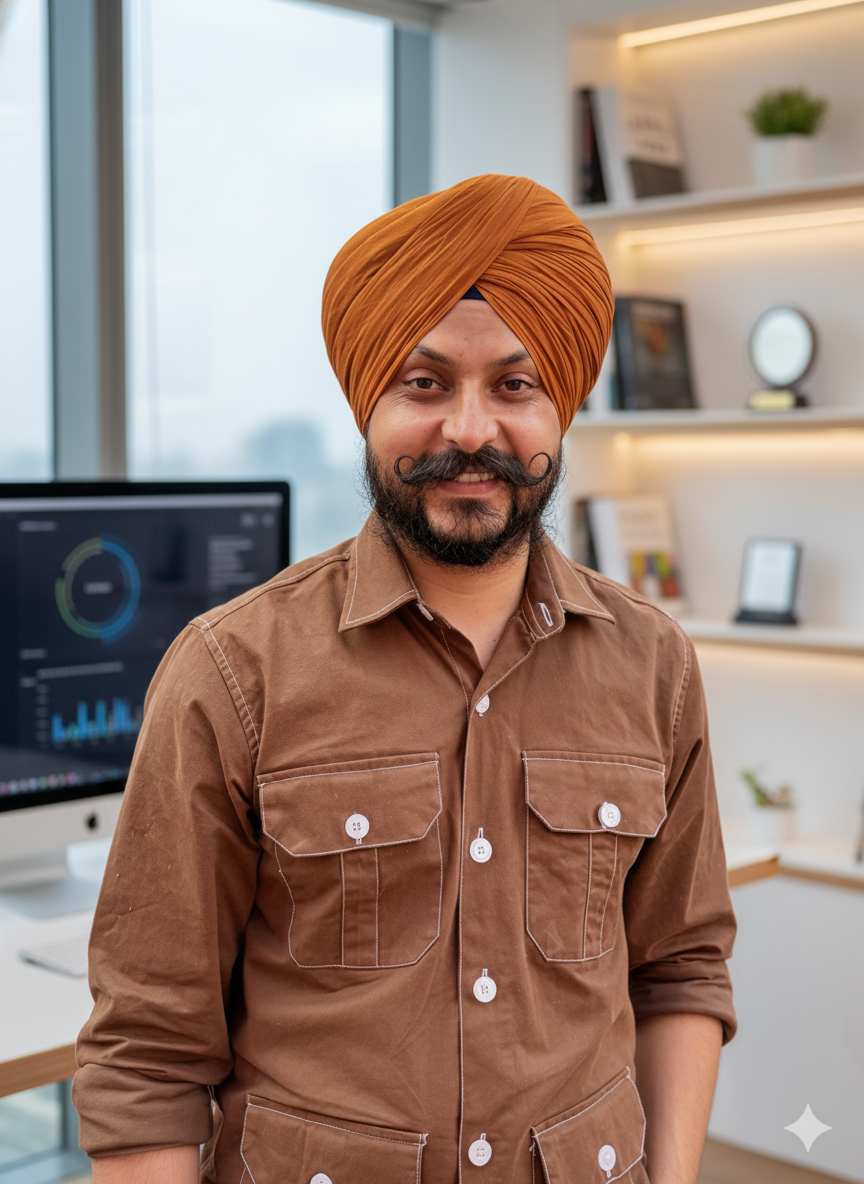
I am Harjinder Singh, Founder & Coach at Top Rank Master with 11+ years of digital marketing experience. I have worked with leading agencies and helped scale multiple brands through SEO, PPC, and performance marketing.
I run Top Rank Master, where I train students and professionals through practical, industry-focused coaching with 100% placement support. I am passionate about helping college students start strong careers and guiding agencies to achieve measurable growth.
Let’s connect if you want to learn digital marketing or grow your business.