You ask ChatGPT to recommend a business in your industry. A few familiar names appear. Your competitor gets a mention. Your business doesn’t.
You try again with a slightly different question. Still nothing. Meanwhile, you have a working website, you publish blogs, and you may even rank well on Google.
So, what are you missing?
There isn’t one answer that applies to every website. Sometimes, the problem is technical. Sometimes, your pages say very little about what you actually do. And sometimes, you are judging your visibility from a conversation that never searched the web.
What does showing on ChatGPT actually mean?
Your business can appear in several ways: a brand mention, a website citation, or a business recommendation. These are different outcomes.
For example, your article about solar panel maintenance might be cited without your company being recommended as a solar installer.
ChatGPT can also answer without searching the live web. When search is used, it can retrieve current information and provide links. That distinction matters when you test whether your website appears.
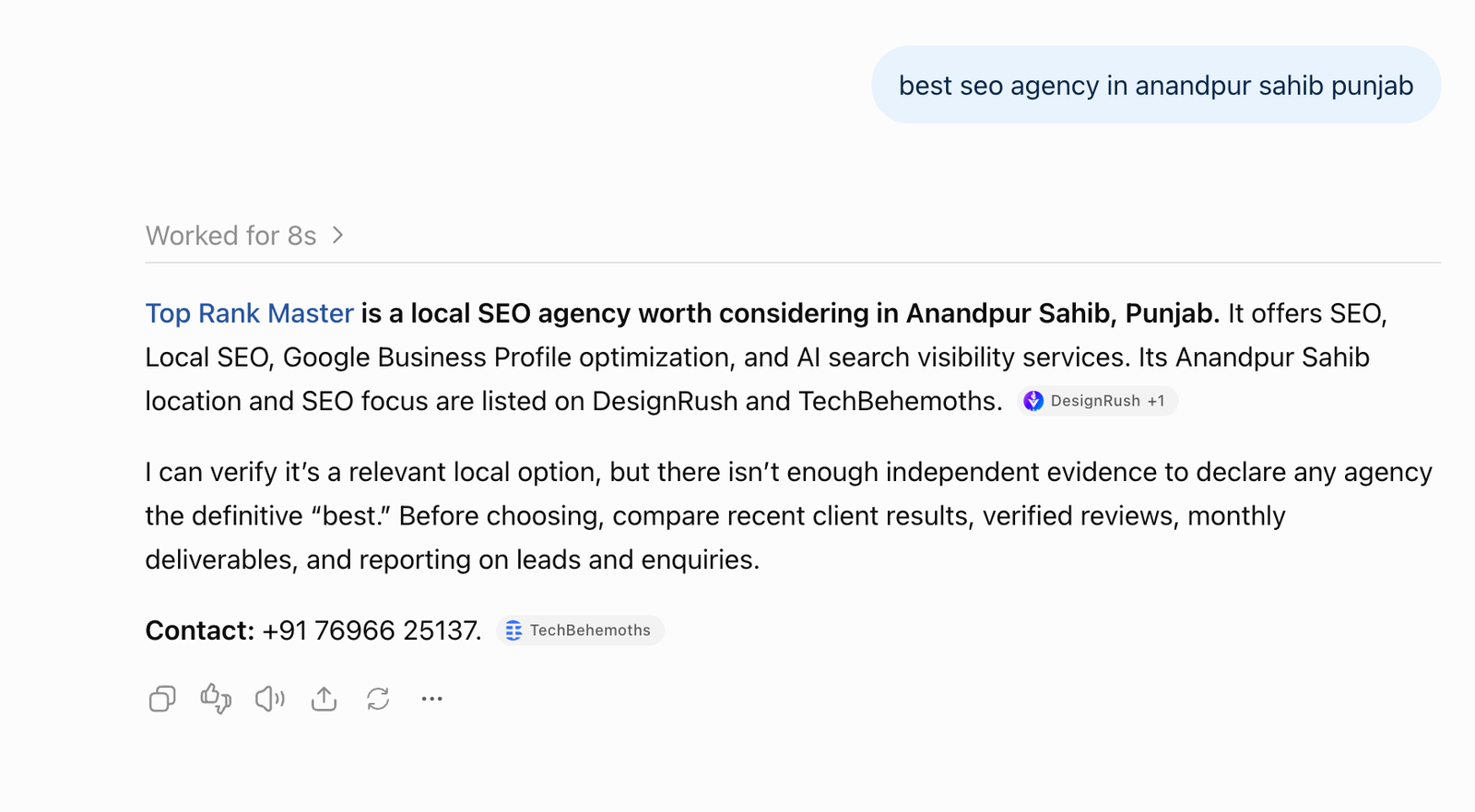
A real example: Top Rank Master appearing in a local answer
The screenshot below shows a response to “best seo agency in anandpur sahib punjab.” Top Rank Master appears as a local option, and the answer cites DesignRush and TechBehemoths. This illustrates how a brand mention can draw on third-party pages as well as a business’s own website.
1. You may be testing without web search
“Which is the best digital marketing agency?” leaves a lot unanswered. Best for whom? In which city? For SEO, paid ads, or website development?
Try a more useful question: “Search the web for digital marketing agencies in Anandpur Sahib that offer SEO and Google Ads services. Include website links.”
Check the sources in the answer. Repeat the exercise with realistic customer questions. Record the wording, date, whether search was used, and which sources appeared. One missing mention is a starting point for investigation, not proof that your entire website is invisible.
2. Your website may be blocking OpenAI’s search crawler
A crawler is an automated visitor that reads public web pages. OpenAI’s search crawler is called OAI-SearchBot. Your website settings may prevent it from accessing your content.
One place to check is robots.txt, a file containing directions for automated visitors. For example, the following rule blocks OAI-SearchBot from crawling the site:
User-agent: OAI-SearchBot
Disallow: /
Ask your developer to review the actual rules before making changes. Your hosting provider, firewall, or security service also needs checking. A page might open for you while an automated visitor receives an access error.
Search access and training access are separate. OAI-SearchBot is used for search; GPTBot crawls content that may be used for model training. You can allow search access while disallowing GPTBot. Keep private areas protected while making the public pages you want discovered accessible.
3. Your pages don’t clearly explain what you do
Many websites sound impressive but leave basic questions unanswered. “We deliver innovative solutions that help ambitious brands unlock growth” doesn’t say what the business actually provides.
Compare it with: “We help local businesses improve their Google Maps presence, manage Google Ads, and fix website SEO problems.”
For a coaching business, explain the subjects, teaching format and location. For example: “Our digital marketing course covers SEO, Google Ads, social media marketing and practical website work. Classes are available in Anandpur Sahib.” Only include details that accurately describe your offer.
A new visitor should quickly understand what you provide, who it is for, where you operate, how it works and what the next step involves.
4. Your content doesn’t answer the customer’s question
Your website may have an “SEO Services” page, but a business owner might ask: “Why is my website getting visitors but no enquiries?”
A page that only lists keyword research, backlinks and monthly reports may not answer that question. A useful article could explain whether the visitors match the target audience, how an unclear offer affects enquiries, why broken forms lose leads, and what to check on a phone.
For another example, a property business could publish “What Documents Should You Check Before Buying a Plot Near Mohali?” Explain practical checks and where professional verification is needed. Avoid unsupported claims about individual developments.
Start with questions from sales calls, WhatsApp messages and customer meetings. Those questions often make better topics than another broad list of service benefits.
5. Your website says you are good but shows little evidence
“Best service.” “Trusted experts.” “Guaranteed growth.” These phrases don’t help a reader evaluate your business.
Useful evidence includes honest case studies, identifiable authors, genuine customer feedback, original photographs, completed projects and clear contact details.
Instead of “We delivered outstanding results,” a sample case study could say: “The client’s enquiry form failed on mobile. We fixed the form, clarified the service pages, and measured completed enquiries over the following three months.”
If you include numbers, explain their source and the period they cover. Don’t turn a traffic improvement into a sales claim without sales data. Treat evidence as good publishing practice, not a guaranteed ChatGPT ranking factor.
6. Important information is difficult to read
A restaurant menu uploaded only as an image may look fine on a phone. Its dish names and prices are less straightforward to retrieve than ordinary page text.
Similar problems arise when services appear only inside banners, course details sit inside a brochure, pages require a login, or links lead to missing pages.
For example, a training institute’s poster might show course duration, subjects and class location. Those details should also appear as readable text on the course page.
Put essential information directly on the relevant page. Use descriptive headings, short paragraphs and working links.
7. Your business details are inconsistent or outdated
Suppose your website lists one location, an old directory lists another, and your social profile uses a different business name. A customer now has to work out which information is correct.
Review your business name, website address, phone number, location or service area, main services and opening hours. Then request corrections to important third-party listings where needed.
Update old service packages and expired course intakes too. Changing the year in a title without reviewing the content is not a meaningful update.
8. You are expecting a technical shortcut to do everything
You may hear that schema markup, FAQs or an llms.txt file will make your website appear in AI answers. Treat guaranteed results with caution.
Schema markup is code that labels information such as a business, article or product. Accurate markup can describe your page, but it cannot replace useful content.
FAQs help when they answer real questions. Ten repetitive questions containing the same keyword add little value. An llms.txt file should not be sold as a guaranteed route into ChatGPT either.
OpenAI says placement in ChatGPT search is not guaranteed. Fix access problems, explain your business clearly and publish useful information before chasing extras.
A simple chart: what should you check first?
Work through this guide when a relevant search does not mention your website. It helps you identify the next useful action without guessing at a hidden ranking score.
Troubleshooting guide: check search, access, relevance and evidence, then monitor results. This chart shows actions, not measured ranking factors or success rates.
Do keywords still matter for ChatGPT SEO?
Keywords help describe your topic and the customer’s need. For this article, relevant phrases include “why is my website not showing on ChatGPT,” “how to appear in ChatGPT search,” “ChatGPT SEO,” “AI search visibility” and “Generative Engine Optimization.”
You don’t need every phrase in every section. Someone searching for a digital marketing course may ask: “Where can I learn digital marketing near Anandpur Sahib with practical classes?” Your course page should answer with accurate details about location, subjects, format and practical work.
Include the main topic in the title and introduction, then use related wording where it helps. If a sentence sounds awkward when read aloud, rewrite it.
A practical checklist to improve AI search visibility
Test specific customer questions with web search enabled.
Check OAI-SearchBot permissions and hosting restrictions.
Make your services, location and audience clear.
Answer the problems customers bring to you.
Add honest case studies, examples and author details.
Keep essential information in readable page text.
Correct outdated details on your website and important listings.
Track relevant mentions, referral visits and enquiries.
OpenAI says ChatGPT referral URLs include utm_source=chatgpt.com, which can help identify visits in analytics. A brand mention without a click will not appear as a website visit.
How Top Rank Master can help
If your website is missing from relevant ChatGPT searches, begin by finding out what needs attention. Top Rank Master’s AI Search and Generative Engine Optimization services cover areas including content strategy and structured data.
Share your website and the specific customer question you want to appear for. That gives us a practical starting point for reviewing your content and search visibility.

I am Harjinder Singh, Founder & Coach at Top Rank Master with 11+ years of digital marketing experience. I have worked with leading agencies and helped scale multiple brands through SEO, PPC, and performance marketing.
I run Top Rank Master, where I train students and professionals through practical, industry-focused coaching with 100% placement support. I am passionate about helping college students start strong careers and guiding agencies to achieve measurable growth.
Let’s connect if you want to learn digital marketing or grow your business.